Case study 01 · This website
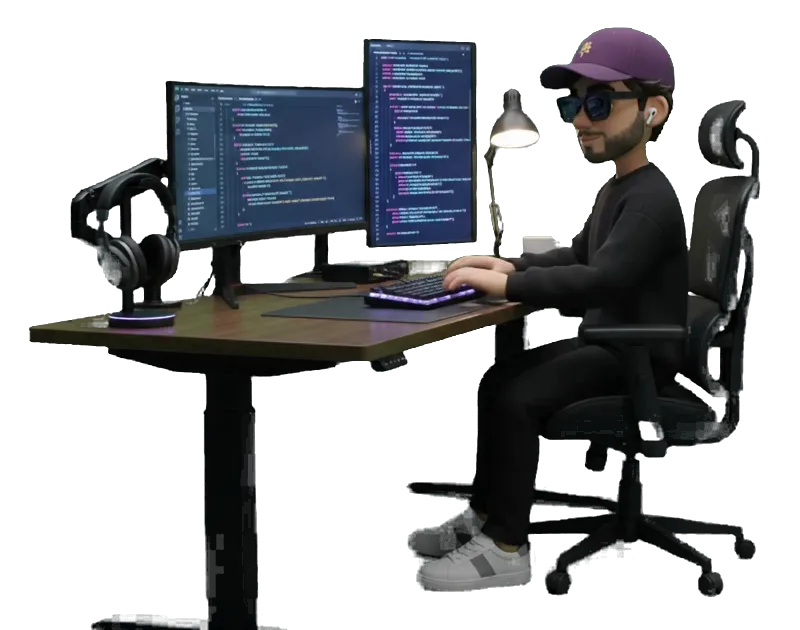
He isn't a 3D model.
The character who watches your cursor is 55 video frames, five short clips and a little trigonometry. This is how he was made, start to finish.
Scroll to turn him round
01 · Source
Shoot it on green.
Every clip starts from one master image, animated in Google Flow against a flat green wall: 720 × 1280, 24 frames a second, six seconds each. Green, because nothing he wears is.
04-look-circle.mp4 · 144 frames
02 · Key
Take the wall away.
ffmpeg removes the green. The obvious filter, chromakey, ignores brightness and ate his black sweater, so the key measures plain RGB distance instead, kept tight enough that the beard stays solid. The wipe you are scrolling is the same maths, running in a shader.
colorkey=0x109757:0.12:0.06,despill=type=green
03 · Sprite
One slow look around, cut into frames.
In a single clip he turns away from the camera, then sweeps his gaze through a full circle. Every second frame goes into one image: one pose facing you, 12 turning away, 42 around the ring.
look.webp · 8 × 7 cells
04 · Follow
The angle of your cursor picks the frame.
Move the pointer around him. Its angle maps to a place on the ring, and he gets there through the real frames in between, the short way round. Nothing is blended or generated on the fly, so nothing smears.
atan2(dy, dx) → cell 13…54
05 · Rest
Stop moving and he comes back to life.
After 1.6 seconds of stillness he returns to the camera, and a looping clip takes over from the very same pose: breathing, shifting his weight. Move again and the frames pick up where the film left off.
idle.webm · VP9 with alpha, HEVC for Safari
- 55frames
- 5clips
- 2codecs
- 03D models

Case study 02 · tinaandemmanuel.me
An invitation that flows.
Our wedding invitation, built for our guests as one long scroll-painting: two streams rise in the mountains, travel side by side, and become one.
33 commits · April to October 2026

01 · The world
Scroll down, travel sideways.
The page scrolls down while the world slides sideways, one pixel for one pixel. A fragment shader paints the two streams live as watercolour, rose and indigo, and the paper itself warms from dawn to dusk along the way.
River.tsx · OGL fragment shader

02 · The confluence
Where they meet, the river rises.
At the confluence the world holds still and the water climbs over the whole screen. The two colours steep into one while a poem is read, then the water drains back and the journey goes on. The pointer stirs it; a tap sends a ring across it.
Water.tsx · two pigments, one pool
One second of keyed video
Before · CPU loop, throttled to 24 frames
After · GPU shader, every frame the screen draws
03 · Performance
Lighter every week.
The keyed videos began as a loop over every pixel on the CPU, throttled to 24 frames a second, and moved into a WebGL shader. Three.js and react-three-fiber gave way to OGL, the smooth-scroll library came out, and phones got their own smaller encodes.
CPU pixel loop → GPU shader
04 · The reply
A guest list in a spreadsheet.
A guest can be sent a link with their own name in it and be greeted by it. Replies go straight into a Google Sheet through an Apps Script, so the site needs no server and ships as a static export on GitHub Pages.
Next.js static export · Apps Script
Case studies 03–05 · Production
Now the day job.
Three systems built and shipped for 200,000 daily users, each one taken apart below.
Built With Intention.
Three engineered chronicles. Detailed dissections of production systems architected and delivered for 200,000 daily users: deterministic AI copilots, distributed batch optimizations eliminating 99.7% of database bottlenecks, and 60 FPS matrix virtualization.
The Clockwork Sentinel // Autonomous Enterprise Copilot
Deterministic multi-gate workflow engine capable of autonomously orchestrating high-concurrency payroll runs, biometric attendance reconciliation, and statutory filings. Features strict RBAC validation, honesty guards against masked errors, and real-time bidirectional UI viewport synchronization.
A payroll cycle crosses attendance sync, calculation, audit, sign-off and statutory filing. An agent that runs them for you is only safe if a step that fails quietly cannot pass as done.
- 1One gate per stage
Each stage is a gate with its own authority check, and the run cannot skip ahead.
- 2Fail closed
Four gates stop the run on any failure. The first halts and waits for a person to approve.
- 3Honesty guard
An interceptor reports a silent 201 as a failure instead of letting it count as success.
- M1 · Ingestion320ms
- M2 · Worker42s
- M3 · Audit850ms
- M4 · SecurityInstant
- M5 · Statutory1.2s
Initiating declarative Payroll Autopilot for Bangalore HQ (1,420 employees). Verifying pre-flight gates and biometric reconciliation...
Manager override authenticated via stored reporting authority. Signed entry written to ai_agent_auditlog. Dispatching Celery background worker...
Payroll computation verified in 42.0s with zero variance errors. Compiling statutory compliance bundle (PF ECR, ESI, PT, Form 24Q).
Rivers in the Machine // High-Throughput Batch Optimization
Engineered distributed performance overhaul for core batch calculations servicing 150K–200K active employee records across multi-tenant environments. Eliminated cascading N+1 database queries via bulk replica joins and built resilient asynchronous request logging queues with automatic reconnect retry.
Every employee triggered its own override read and payout write: 2N+1 queries. At this size the run takes about 70.4s, past the 60s load balancer ceiling, so it ends in 504s and retry storms while holding 96% of the connection pool.
- 1Bulk replica preloads
One read-replica call loads the tenant's register, joined in memory by hash index.
- 2Resilient telemetry queue
Audit writes moved off the response cycle onto an async queue with an immediate single retry.
- 3Hardened tenant scoping
Directory export lookups carry a tenant predicate, so nothing crosses tenants.
- DB queries · before5,001
- DB queries · after3
- Run time · before70.4s
- Run time · after0.8s
- Connection pool · before96%
- Connection pool · after7%
Modelled figures. Drag the simulator below to change the batch size.
Drag slider to observe computational divergence between legacy iterative N+1 queries and the optimized batch read-replica engine.
- 1x Batch initialization fetch
- 2,500x Employee override queries
- 2,500x Bulk payout status writes
- Total: 5,001 TCP network roundtrips
- 1x Bulk pay register fetch from read-replica
- 1x Bulk copy-override in-memory hash join
- 1x Chunked payout status batch update
- Total: Exactly 3 batched queries (O(1) invariant)
Eliminated the per-employee query cascade by materializing tenant company registers in one read-replica call and performing in-memory hash index joining.
Decoupled API response cycles from DB audit writes using an asynchronous request_queue with immediate single retry to survive broker disconnects.
Enforced tenant predicate scoping on directory export UUID lookups to structurally guarantee zero cross-tenant entity leakage.
The Infinite Loom // High-Throughput Virtualized Pay Register
Real-time payroll register stress-test demonstrating row windowing over massive 10,000+ data sets. Decouples DOM complexity from dataset volume for a locked 60 FPS experience with microsecond frame budgets.
The pay register mounted every row it was given. With 1,120+ DOM nodes live, scrolling fell to about 18 FPS and memory sat at 186MB.
- 1Window the rows
Only the rows inside the viewport are mounted, plus three either side as overscan.
- 2Fixed row height
Every row is 44px, so the first visible row is one division with nothing to measure.
- 3One offset
A spacer keeps the full scroll height and the mounted rows are translated into place.
- Frame time · before42.8ms
- Frame time · after< 1.5ms
- DOM nodes · before1,120+
- DOM nodes · after28
- Memory · before186MB
- Memory · after14.2MB
Switch Engine Mode below to scroll both versions.
Chapter 04 · The handshake
Your move.
That is the story so far. The next chapter could be yours: I am available for engineering roles where concurrency, rendering performance and systems quality matter most.
Immediate joinerBangalore, India